
Many businesses require extended coverage. For example, many tech, travel, and hospitality companies often need 24-hour coverage, including those in the outsourcing industry, supporting many of those same businesses.
When companies need extended coverage, one of the most vital things to consider is scheduling their employees' work shifts. Getting it right is essential to increase customer satisfaction, control labor costs, and keep customers happy. However, if you get it wrong, then your business can suffer. This article discusses the options to consider when creating a sustainable work shift schedule for your employees.
Any typical office job follows regular business hours the standard 9:00 AM to 5:00 PM, Monday through Friday. But businesses that need to operate longer than the corporate eight-hour workday, or around the clock, need shift work to keep things running smoothly. The most common options when scheduling employees for shift work are:
Although splitting schedules into shifts is easy, knowing the best strategy for assigning employees is another thing. Creating fixed shifts is the simplest method. Certain employees are scheduled to work days or afternoons regularly, while others always work nights. The disadvantage of this is that you might not have enough qualified staff keen to work nights. So, depending on the demand of operations, here are common types of work shifts you can adopt.
If you need your employees to work consistent weekly shifts, fixed shifts are the way to go. Employees get a steady routine by consistently scheduling them in one type of shift. However, fixed shifts do not mean that all your employees work simultaneously. Some employees work one set of hours, while others work a different set of hours. There are three regular shifts for this type of work shift: first, second, and third.
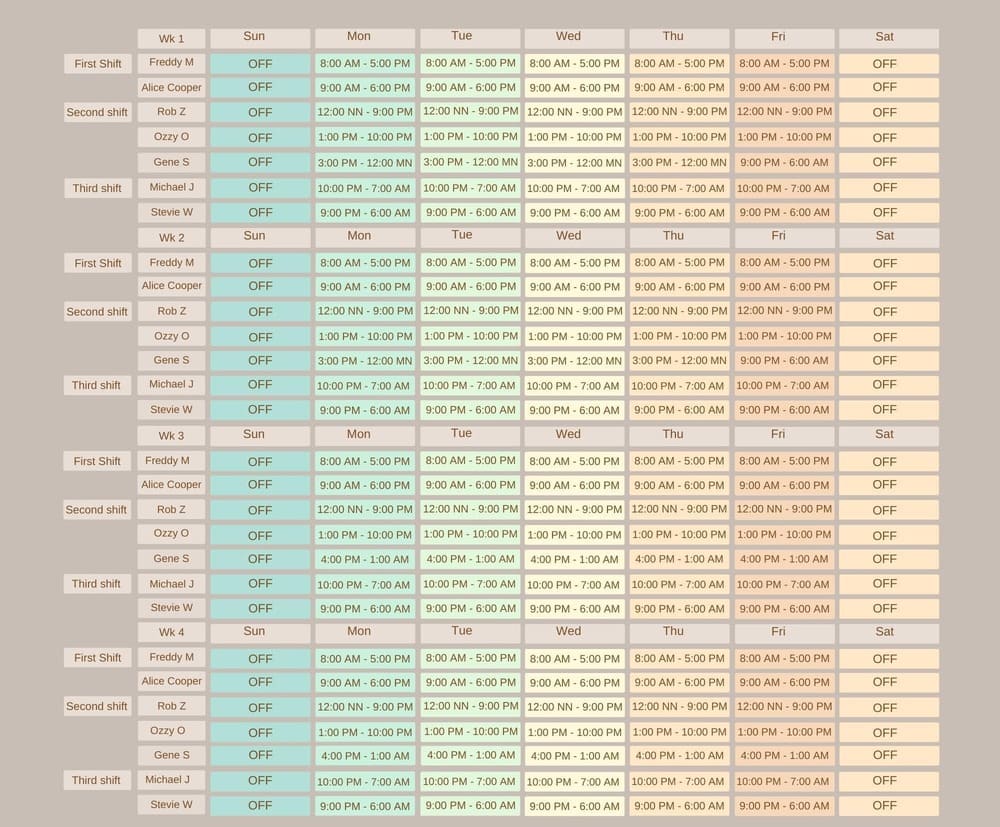
This is known as the day shift and is usually in line with the traditional working days with a schedule that begins at 8 AM or 9 AM and ends at 5 PM or 6 PM. Working on the first shift means you get a standard workday. In addition, you get the morning and evening commute and evenings off. Office-based and manufacturing companies require employees to work the first shift.
The second shift, commonly called the swing shift, runs from the afternoon, around 4:00 PM to midnight. The timing of this shift can also vary. Sometimes, the shift may begin as early as 11 AM or as late as 5 PM. This can often be the busiest shift of the three in many hospitality and customer service industries.
The third shift is known by many names: the graveyard, midnight, or night shift. Hours scheduled for this shift may differ between employers, but the third shift usually begins between 10:00 PM and midnight and ends anywhere between 6:00 AM to 8:00 AM. One of the perks of working the graveyard is the higher pay rate (night differential pay) that comes with it. Even if they are considered least preferred or even undesirable, the night shift is essential for roles like policing, healthcare, and outsourcing professions.
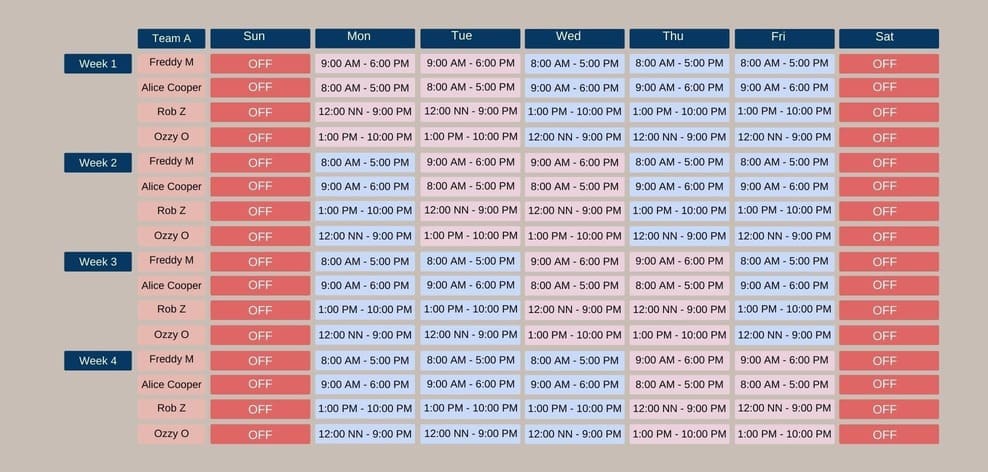
Rotating work shift or rotational shift work means rotating schedules that are opposite to fixed shifts. In other words, they work irregular hours throughout the week. Employees get alternated between shifts on a set schedule or, most often, depending on the company's needs. An employee on a rotating schedule, for example, might work the first shift on Monday and Wednesday, the third shift on Tuesday and Thursday, and the second shift on Friday and Saturday. Employers use rotating work shifts so employees can change up their work schedules from day to day.
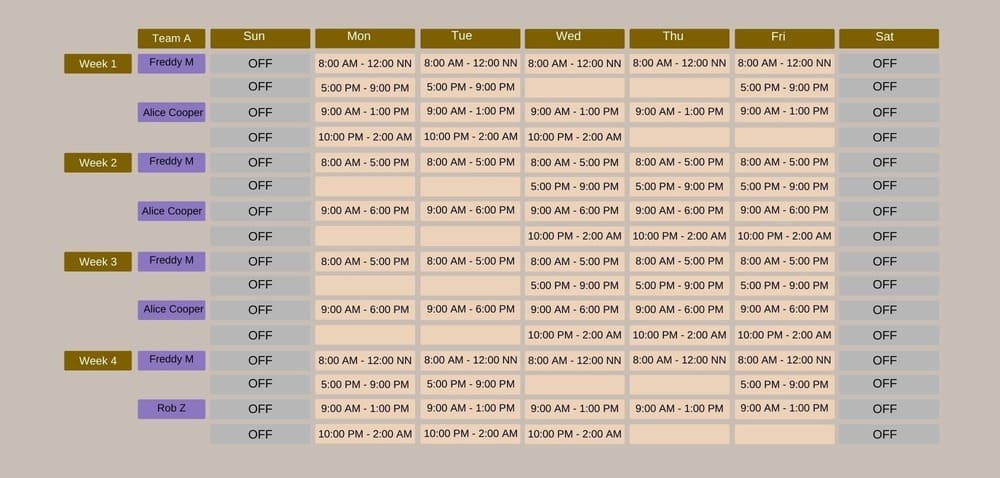
Sometimes jobs don't match up well with the conventional shift times. This is when employers use the split shift. A split shift is when an employee works two separate shifts on the same day. Split shifts are standard in workplaces with peak hours throughout the day, like the hospitality or restaurant industries. The long breaks between the scheduled shifts, usually the long quiet spells for businesses, separate these two shifts.
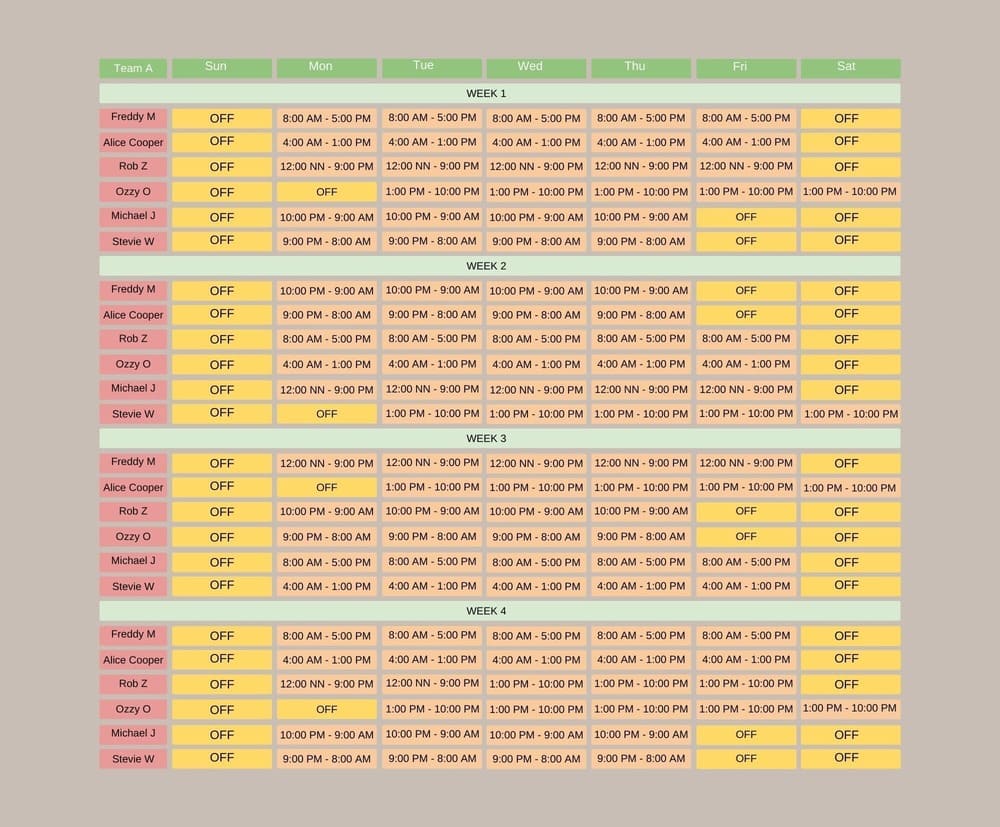
For businesses committed to providing services to customers outside the traditional eight-hour work day, extended shifts, overlapping shifts, or modified shift work is recommended. For example, a web development company posts on its website that customer service and technical support are available Monday through Sunday, 7 AM to 10 PM ET. People working at the beginning and the end of the shift will have crossover time with other employees, but their work hours are modified to provide coverage. For example, an employee might work from 7 AM to 4 PM, while another employee might work from 1 PM to 10 PM.
Employees of the 21st century are redefining the way they work. More people shift to the mindset of working to accommodate their lifestyle. But, for businesses, it is essential to recognize that such personal preferences may not be aligned with the growth that the company has mapped out for the team and the business. Setting up shift work at your company allows you to cater to your employees' varying needs and preferences while also sticking to your company's growth roadmap.
In his book, Managing the Professional Service Firm, David Maister wrote that scheduling work shifts determines the team's quality, the job's economics, and the skill-building and motivation of professionals doing the work. Implementing a well-oiled shift management system will be able to individually work with your employees, align their objectives and help them build their skills for the work they need to do. In addition, with proper communication, employees will have excellent internal rapport and achieve better productivity.
With the right shift strategy, companies can gain a competitive advantage and have the flexibility to offer round-the-clock support. Supply chains need 24/7 support. It's not just a need but a requirement. Two cost-effective methods of accomplishing this are hiring an outsourced staff or integrating outsourced professionals into your in-house team. In the right circumstances, outsourcing customer service can save you time compared to options such as hiring in-house staff and managing your own freelancers.
With your increased capacity from outsourcing, you expand your support solutions for your partners globally. At eFlexervices, we provide a dedicated support team that values relationship-building, has strong industry knowledge, offers multilingual support, and helps you streamline your operations. We are flexible regarding delivering the correct type of work shift your company needs. We ensure optimum productivity levels and consistently provide our partners with the proper support to drive growth.