
BLS Projects Two Opposite Futures for Accounting. Most Teams Have Both Jobs in One Person.

By Rob Astudillo, CEO, eFlexervices
Bookkeeping, accounting and auditing clerks number 1,532,400 jobs in 2025 and are projected to decline 6% by 2035, losing 85,600 positions, with median pay at $50,670. Accountants and auditors number 1,595,200 and are projected to grow 5%, adding 79,400 positions at a median of $83,680.
Two occupations inside the same function, almost identical in size, heading in opposite directions over the same decade.
The wider pattern holds as well. BLS projects office and administrative support to decline 4.0% and shed 752,100 jobs between 2025 and 2035, which is the largest decline of any major occupational group.
What the split is describing
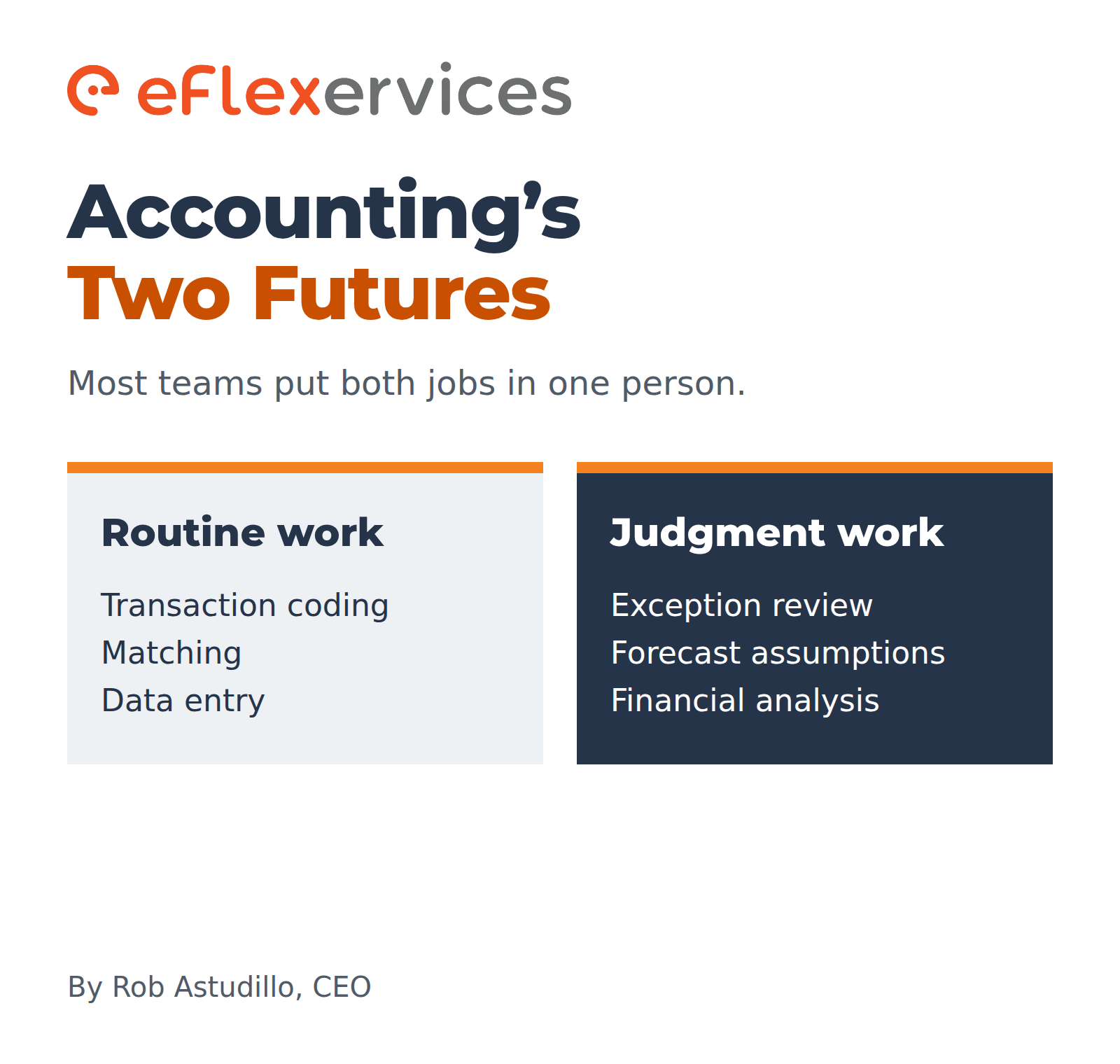
Automation removes high-volume, rule-based, verifiable work, including transaction coding, matching, data entry, and routine reconciliation. It does not remove the work of deciding what a number means, whether an exception matters, or what to tell a lender about next quarter.
The first category is shrinking and the second is growing, which is a narrower claim than a forecast about what AI can do. BLS is projecting which tasks still need a person attached to them.
Why the savings have not shown up
Here is the part that finance leaders tend to recognize immediately when I describe it.
In a company under a few hundred people, two categories of work aren't held by two groups of people. The same people hold both. The Controller who interprets variances also chases source documents, and the senior accountant who owns technical judgment also runs the reconciliations.
Automate the clerical half and that person still has the other half, so you have not freed a role; you have changed the mix inside one job. That is why close-automation software has produced less relief than its business cases promised: the constraint was never only hours. The hours and the judgment were bundled into the same headcount, and software addresses only one.
The sequence that works
Separate the work before you automate it.
Write down which parts of your month-end require somebody to decide something and which parts require somebody to be accurate and consistent. In most teams I have seen, the split runs roughly 70/30 toward the second category, and both halves currently sit with the most expensive person in the finance function.
Once they are separated, the two halves have genuinely different solutions. The consistent work can be automated, or staffed at a rate matching its value. The judgment work stays with your senior people, who now have room to actually do it.
Running that sequence in reverse, automating first and hoping the roles clarify afterward, is how companies end up with a tool subscription and the same bottleneck they started with.
Both halves, in practice
On the automation side, our analyst Jerald took a client's 38 weekly reporting files and reduced them to a single automated report delivered before 8 AM, which is the clerical layer disappearing exactly as the clerk projection describes. His story is here.
On the judgment side, Dianne built forecasting and analysis for a transportation and travel company, which moved that finance function from reporting what had already happened to modeling what was about to. No software produces that shift, because the work is deciding which assumptions hold. Her story is here.
Those are the two futures BLS is projecting, running simultaneously inside the same function.
One number that complicates the story
BLS still projects about 144,100 openings a year for bookkeeping and accounting clerks despite the decline, all of them coming from replacement as people retire or move on.
A shrinking occupation keeps hiring, which means the clerical layer isn't vanishing this decade so much as slowly shrinking while continuing to turn over. Anyone telling you the function disappears next year is selling something.
What is actually happening is slower and considerably more useful to plan around. The routine half of accounting is getting cheaper to cover, and the judgment half is becoming more valuable and harder to hire, so companies that separate the two early will spend the next decade with a structural advantage over those that don't.
eFlexervices places accounting professionals with US finance teams. Tell us what you need covered.